
Increase distrust and polarisation inside democratic societies
How modern Russian influence operations actually work

Response Note to Don Knight
Your article touches on something real, but the story may be less about a single compromised individual and more about how modern Russian influence operations actually work.
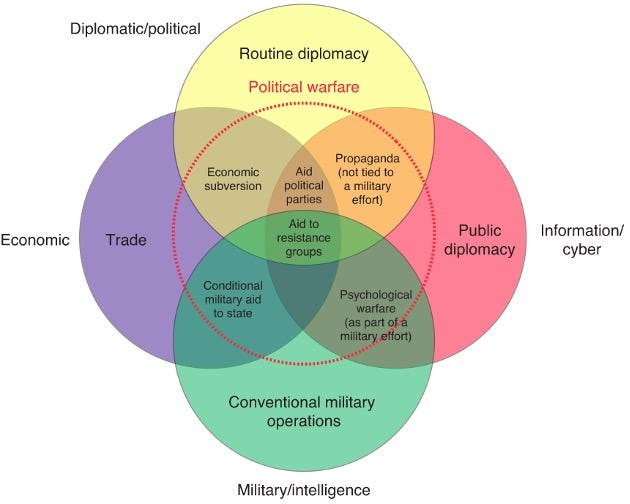
During the Cold War, Soviet intelligence did recruit agents in Western countries. But the KGB—and later the Russian FSB and GRU—also developed something far more powerful: active measures.
The goal of active measures was never simply espionage. It was to reshape the political environment inside rival states.
Former KGB defector Yuri Bezmenov described it clearly: the objective was to alter how a society understands reality itself. Not by convincing everyone of one lie, but by flooding the information space with so many narratives that citizens lose the ability to distinguish truth from manipulation.In that environment, democracy begins to malfunction on its own.
Modern Russia has adapted that strategy to the digital age.
Instead of recruiting large numbers of traditional spies, Moscow now relies on a mix of tools:
• Disinformation campaigns amplified through social media
• Financial influence in real estate, business, and political networks
• Proxy media outlets and influencers pushing polarising narratives
• Cyber operations designed to leak or manipulate political information
• Amplification of domestic political conflict

The objective is simple: increase distrust and polarisation inside democratic societies.
If citizens no longer trust elections, institutions, media, or each other, the system becomes unstable without a single shot being fired.
The Mueller investigation confirmed that Russia ran such influence operations during the 2016 election. Similar tactics have been documented across Europe as well.
But that reality also explains why focusing on the idea of one secret agent—whether real or imagined—can actually miss the larger strategic picture.
Modern influence operations do not require a controlled politician.
They require a divided society.
And when political discourse becomes so polarised that every disagreement is treated as treason, foreign influence campaigns have already succeeded in their most important objective.
In that sense, the real battlefield is not Washington or Moscow.
It is public trust inside democratic societies.